Learn the mapping before the clock matters.
This choice reaction time test asks you to match a displayed shape to the correct button or key. With two choices, Circle maps to D and Triangle maps to F. With four choices, Square maps to J and Diamond maps to K as well. The mapping stays fixed throughout a session, and the buttons show the shape, name and key together.
Begin in practice mode. Start a round, wait for a shape, then select the matching response. Practice responses show feedback but are not added to the scored session. When the mapping feels familiar, choose “Finish practice” and start the ten-round scored test. You do not need to learn an arbitrary color code or distinguish colors to complete the task.
The choice reaction time task supports clicking, tapping and the displayed letter keys. Keep the response area focused for keyboard use. On a small screen, tapping a button includes moving to the target, while a prepared keyboard response may involve less movement. Keep the input method consistent and record it when comparing sessions.
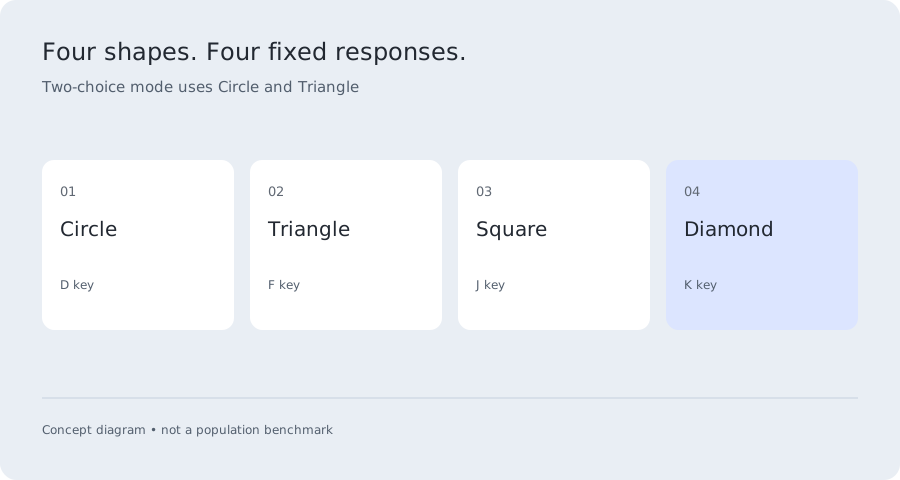
Ten choice reaction time trials, with errors in view.
Each choice reaction time round begins after a random waiting interval. The next shape is independently selected from the active options. Repeats are allowed; the sequence is not forced to alternate. Waiting times are also varied, so a countdown strategy cannot tell you exactly when to respond.
A correct response contributes to both the speed summary and accuracy. A wrong choice counts toward accuracy but not correct-response timing. A ten-second timeout also counts as an unsuccessful scored trial. An early input or a round interrupted by leaving the tab is recorded, excluded from the scored-trial count and retried.
The session ends after ten scored trials. The result panel shows the median and average of correct responses together with accuracy. If every scored response is wrong or timed out, there is no valid speed estimate; the page shows a dash rather than making up a time. You can still download the record and see what happened.
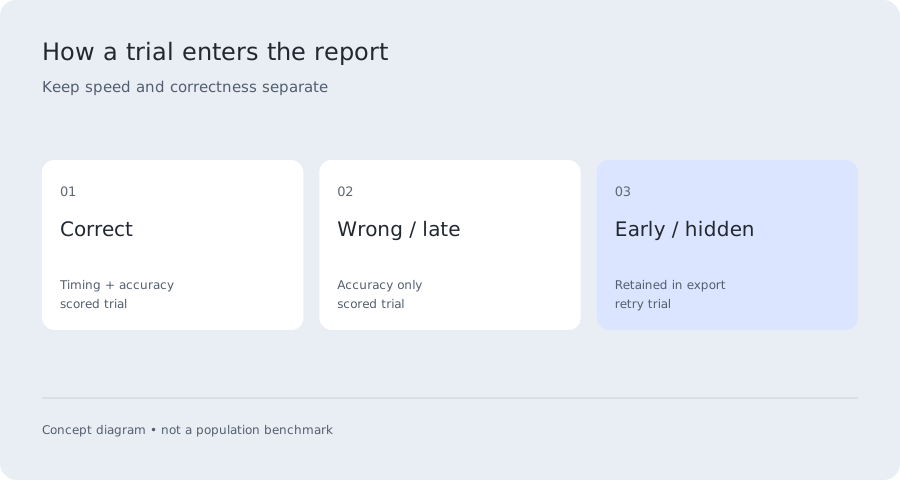
Choice reaction time and accuracy belong together.
A fast choice reaction time is not enough if the response is wrong. Suppose one illustrative session contains eight correct answers out of ten with a 320 ms correct-response median, and another contains ten correct answers with a 370 ms median. The first is quicker on its successful trials; the second is more accurate. Neither single number completely describes performance.
Our tool reports those outcomes separately instead of combining them into an unexplained grade. Compare sessions with the same number of choices, input method and practice conditions. If accuracy changes substantially, describe that change alongside any apparent speed improvement. A strategy of guessing can reduce elapsed times while making the task less successful.
For a choice reaction time experiment, decide in advance whether the instruction emphasizes quick correct responses or another explicit goal. Keep that instruction consistent across conditions. Do not change the scoring rule after looking at which result seems more impressive. This matters in a classroom exercise just as it does in a personal practice record.
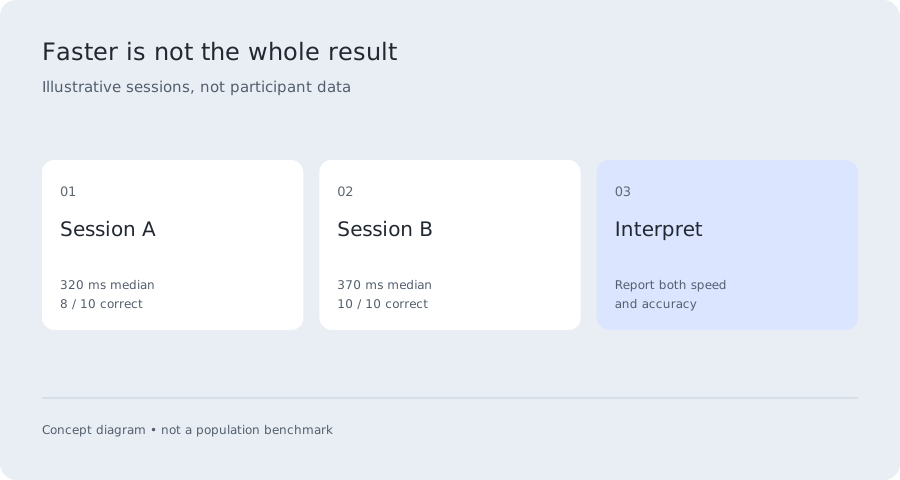
Simple response and choosing a response are different.
In a simple task, one signal requires one prepared action. In a choice reaction time task, you must identify the signal and select the corresponding action. Our two-choice and four-choice conditions change the set of possible responses. They do not simply make the same visual click panel a different color.
The WPI report by Jiang and colleagues studied browser tasks with different decision and dexterity demands. It found substantial effects of those task parameters in its sample. That supports keeping task complexity explicit, but it does not justify predicting your four-choice result by multiplying your simple result by a fixed number.
A choice reaction time example in sport might involve responding differently depending on an opponent’s movement. That real situation adds anticipation, movement and context beyond this shape task. Our test is a small demonstration of selecting a mapped response, not a validated substitute for evaluating performance on a field or in a match.
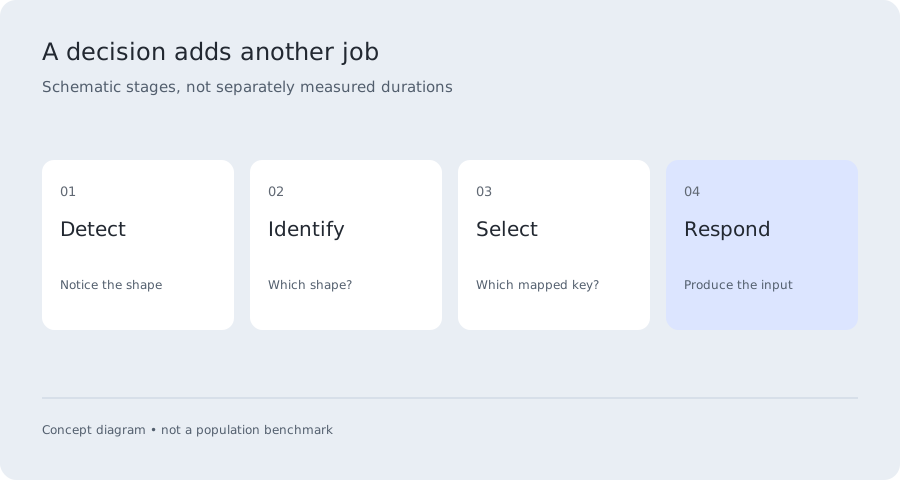
Build a comparison that you can explain.
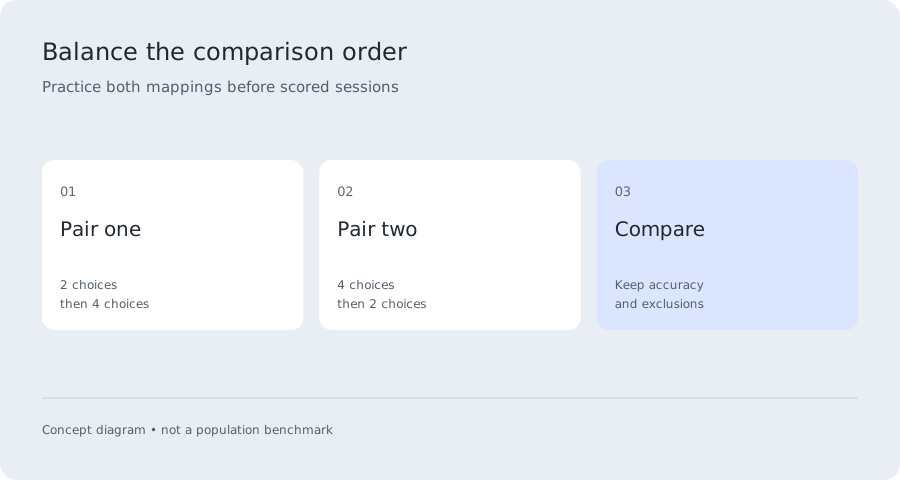
For a short practical exercise, practice both mappings first. Complete a two-choice session and a four-choice session using the same device and input method. Save both CSV records. On a second comparison reverse the order. This helps make practice and fatigue less closely tied to one condition, although a small personal exercise still cannot establish a population effect.
Write down the number of scored trials, number correct, accuracy, correct-response median and mean. Keep early and interrupted attempts visible. Do not compare a four-choice session on a touchscreen with a two-choice session on a keyboard and attribute the full difference to choice alone.
The choice reaction time test export contains the target shape, response status and input method for each recorded attempt. It can be opened in a spreadsheet or retained as a plain record. Results are kept in the tab until reset or navigation; the tool does not build a public leaderboard or an intelligence estimate from them.
Questions, answered.
What is choice reaction time?
It is the interval from a signal to selecting and producing its appropriate response among alternatives. The exact result depends on the mapping, number of options, stimulus, response method and accuracy requirement.
Why are my choice results slower than my simple results?
The task requires identifying and selecting an action, not just executing one known response. Unfamiliar mappings and input movement can also matter. Compare like conditions and check errors before attributing a difference to one cause.
Does the test use color alone?
No. Every option has a distinct shape, a text name and a fixed key. The signal also names the shape. This avoids making color recognition the only way to identify the correct response.
Can I change from two to four choices halfway through?
Reset first so the session does not mix conditions. The number-of-choices control is locked while a session is underway. Practice the new mapping, then start a separate scored session.
What is a good choice reaction time?
There is no validated universal cutoff for this protocol. Report correct-response speed together with accuracy and the number of options. A repeatable improvement under the same conditions is more interpretable than a cross-site grade.
Sources & methodology
Reviewed September 21, 2026. Research values belong to the task and sample named below. Illustrative examples are labelled; they are not population data.
Browser task research supports distinguishing decision and movement demands. Our mapping and protocol are different; no norms are transferred.
An example of a specifically defined research task. Our tool does not reproduce its clinical protocol or diagnostic uses.