Average gamer reaction time is task specific.
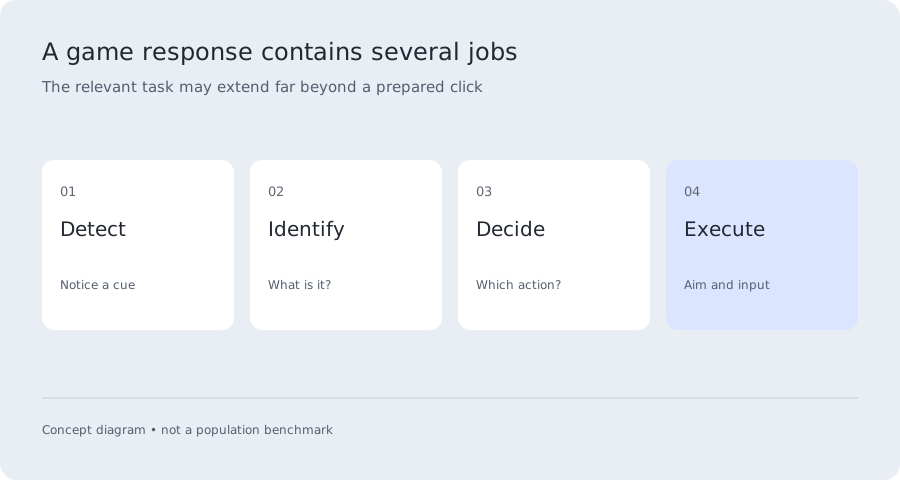
Average gamer reaction time depends on who counts as a gamer and what the test asks them to do. A casual player, a self-rated expert and a professional tournament competitor are different groups. A color-change click, a target-selection task and a live match are different outcomes. One number cannot fairly stand in for all of them.
Our practical answer is to keep those measurements separate. Use the visual test for a prepared single response, the choice test for selecting a mapped action, and a game-specific task for aiming or decisions. Record the exact scenario and settings. A shorter browser score does not by itself predict rank, tournament performance or whether you win an encounter.
Claims about a pro gamer average reaction time often circulate without a sample or protocol. A streamer’s best attempt is a real observation if accurately recorded, but it is not a professional population mean. Before adopting a target such as 150 ms, ask where the number came from and whether it describes an average, a minimum or a promotional example.
Average gamer reaction time in one browser study.
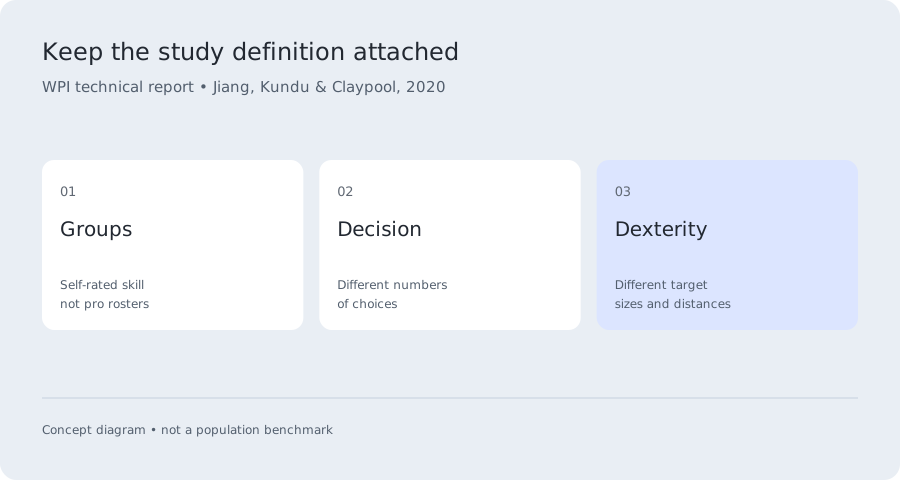
A 2020 WPI technical report by Jiang, Kundu and Claypool describes two browser-based user studies with more than 150 participants in total. Participants self-rated their gaming skill. The report distinguishes decision complexity from target-selection dexterity, rather than assuming every task measures the same underlying number.
The authors summarize simple-response means of about 350 ms for lower self-rated skill and 325 ms for higher self-rated skill, with larger effects from changing the task demands. These are study-specific approximate values. They are not a professional-player norm, a calibration for our tool or a claim that training causes a fixed 25 ms improvement.
When reading average gamer reaction time research, separate an observed group association from a training result. Groups may differ in age, experience, equipment or recruitment. To test whether an intervention causes improvement, you need an appropriate design, not just a comparison between people who already differ.
| Reference detail | What the WPI report supports |
|---|---|
| Group definition | Self-rated gamer ability; not a roster of professional players |
| Task families | Reaction/decision tasks and target-selection dexterity |
| Approximate simple-response means | About 350 ms lower skill; about 325 ms higher skill |
| Interpretation limit | Browser setups vary; findings do not define a universal gamer threshold |
Why an aim task can take longer than a click test.
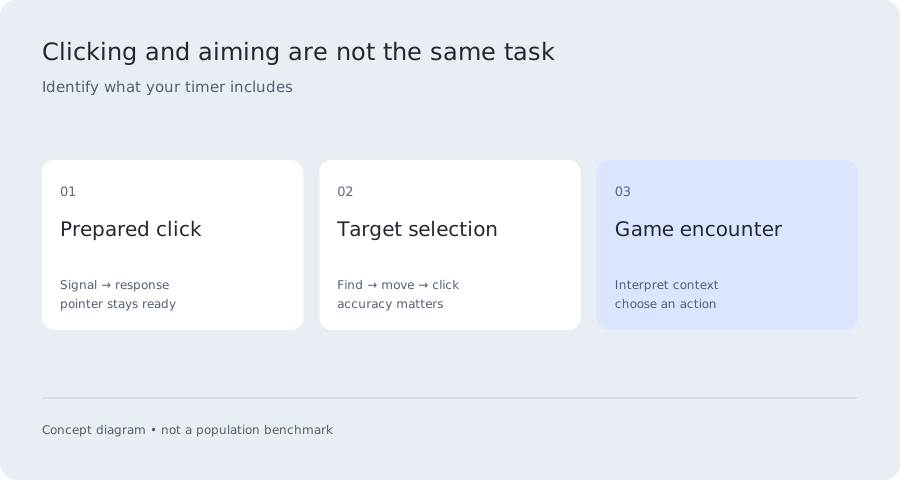
In a prepared click test your pointer need not travel to a new target. You already know the required action. An aiming task may require spotting a target, deciding whether it is relevant, moving the pointer and clicking accurately. The time to finish that sequence includes more than the initial response to a signal.
This distinction matters when comparing average reaction time in CS2 or Valorant. An opponent may appear where your crosshair is already placed, or somewhere you must search for and turn toward. Anticipating a likely location can reduce the work needed after the cue. That is useful game knowledge, but it does not mean a standalone nervous-system measurement has changed.
Choose the outcome that matches your goal. If your difficulty is target acquisition, track an aiming scenario with its accuracy. If your difficulty is selecting the right response, inspect a choice task. Use the average gamer reaction time discussion to clarify the comparison, not to replace game-specific feedback with one browser number.
Keep the hardware condition with the result.
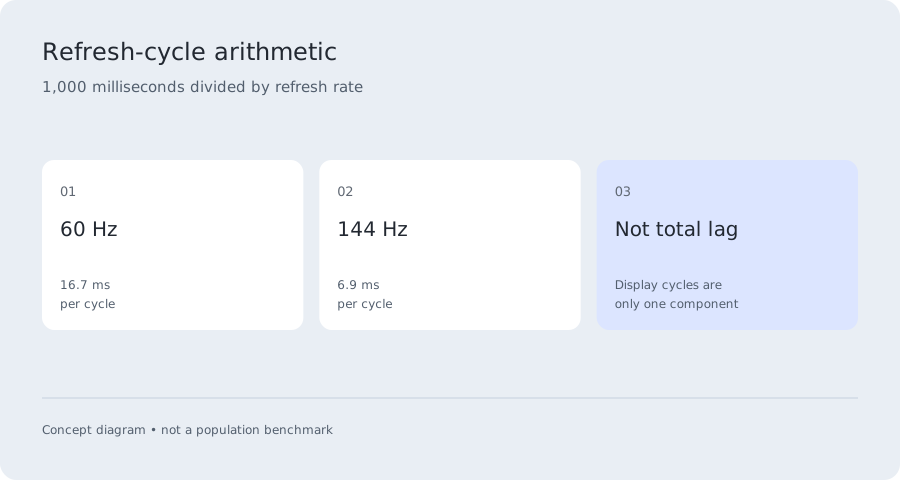
Display timing and input equipment affect browser measurements. A display refreshing at 60 Hz has a frame interval of about 16.7 ms; at 144 Hz the interval is about 6.9 ms. These are calculated cycle durations, not guaranteed reductions in your measured reaction time. Actual latency depends on the complete chain.
If you change a monitor, input device or browser, record a new condition. Compare complete sessions in a balanced order where practical, rather than comparing an old best score with a new average. Do not subtract a monitor’s advertised response-time number from your browser result: pixel transition specifications are not a full input-to-display calibration.
Average gamer reaction time numbers gathered online can mix many setups. That helps explain why a forum discussion is useful for understanding concerns but weak as a controlled benchmark. Our notebook lets you retain settings beside your own values so you can make a narrower, more defensible comparison.
Record your average gamer reaction time with context.
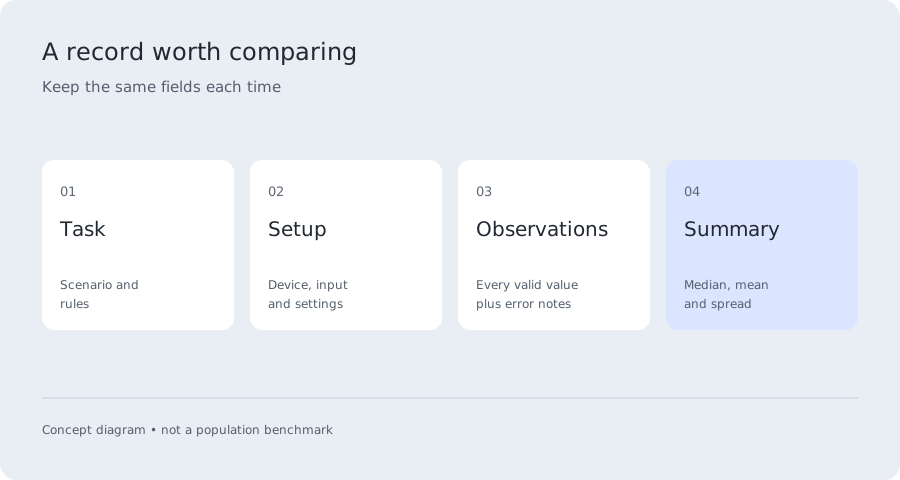
Enter the task or game scenario, your setup and a full set of valid millisecond values in the notebook above. It calculates the median, mean and range without silently removing slow responses. Download the plain-text record before leaving the page. Keep errors, anticipations and interrupted attempts in your notes rather than disguising them as valid times.
For a simple comparison, record one familiarization session and several complete baseline sessions on different occasions. Keep the protocol consistent. If you later change one setting, label it clearly and compare like statistics. Small differences can be ordinary session variation, especially when the number of observations is small.
Your average gamer reaction time question should end with a useful action: identify the skill you want to measure, choose an appropriate task and keep enough context to repeat it. There is no requirement to reach a particular millisecond value before enjoying a game or improving other parts of your play.
Questions, answered.
What is the average reaction time of a pro gamer?
The sources used here do not establish a representative professional-player mean for this exact task. Published values and individual demonstrations use different protocols. We therefore do not invent a pro target or label a browser result professional.
Does 200 ms mean I should be good at Valorant?
No. A prepared visual click leaves out decisions, crosshair placement, target acquisition and many other parts of play. Use it as one measurement, then evaluate performance in a clearly described game scenario.
Can I compare a mouse session with a phone session?
Keep them as separate conditions. Their input and display chains differ. Combining them into one average gamer reaction time can obscure the very difference you are trying to understand.
Should I focus only on my fastest attempt?
Keep a full session and its accuracy or exclusions. A minimum is sensitive to anticipation and selection. A stable distribution across repeated sessions provides a more useful baseline than a single highlight.
Sources & methodology
Reviewed September 21, 2026. Research values belong to the task and sample named below. Illustrative examples are labelled; they are not population data.
WPI technical report; browser studies, self-rated skill groups and task-dependent results. Not a professional-player census.
Supports keeping apparatus effects separate from interpretation of individual performance.